
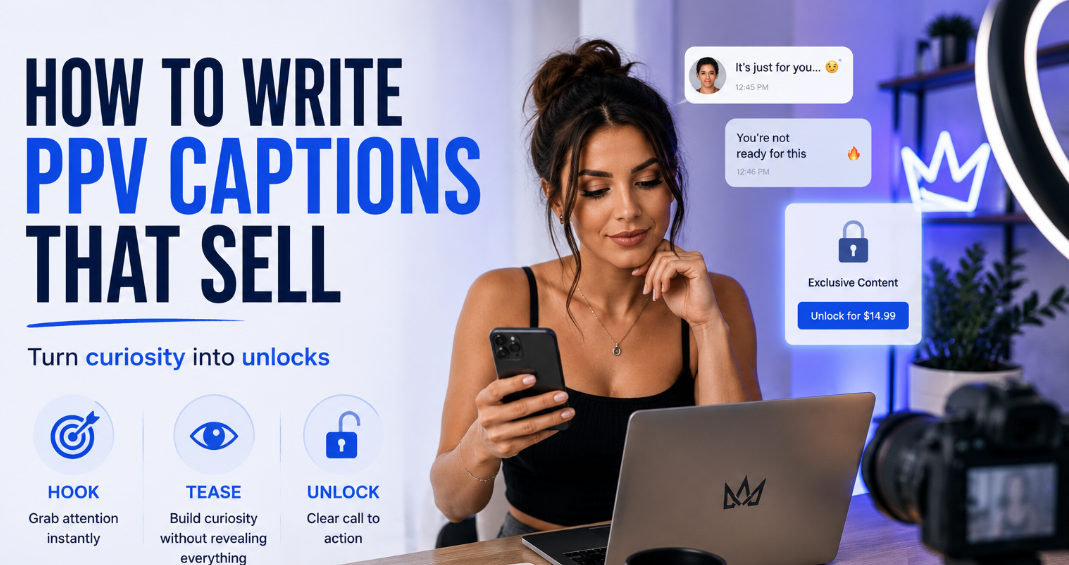
How to Write PPV Captions That Sell
A pay-per-view message lives or dies on its caption. The content behind it might be your best work yet, but if the few lines sitting above the unlock button do not earn a tap, that content never gets seen and never gets paid for. For most creators, the caption is the single biggest lever on PPV revenue, and it is also the one most often rushed.
This guide breaks down how to write PPV captions that sell. You will learn what actually drives an unlock, how to structure a caption so every line pulls its weight, and a set of reusable formulas you can adapt to any piece of content. The aim is simple: more unlocks from the same audience, without dropping your prices.
What makes a PPV caption work?
A PPV caption has one job: to make the reader feel that what is hidden is worth more than the price to reveal it. It is not a description of the content. It is a piece of persuasion.
The best captions do three things at once. They grab attention in the first few words, they build enough curiosity that not knowing becomes uncomfortable, and they make the action obvious and easy. Everything else is detail. When a caption falls flat, it is almost always because it skipped one of those three jobs, and usually the one it skipped was the curiosity.
The psychology of the unlock
People do not buy content. They buy the feeling of finding out. The gap between what someone knows and what they want to know is where desire lives, and a good caption widens that gap on purpose.
This is why describing your content in full is a mistake. If the caption tells the reader exactly what they are getting, there is nothing left to wonder about, and wondering is what drives the tap. Your job is to say just enough to spark the question in their head, then leave the answer behind the paywall.
Emotion matters more than information here. A caption that makes someone feel chosen, teased, or slightly impatient will outperform one that simply lists what is inside. Write to the feeling first and the facts second.
The anatomy of a high-converting caption
Most strong PPV captions follow the same three-part shape: a hook, a tease, and a call to action. Keep them short. Three to four lines are usually plenty, and on mobile, a wall of text gets skimmed and skipped.
The hook
The hook is your opening line, and it has to stop the scroll. It should speak directly to one person rather than a crowd, and it should hint that something good is coming. Open with the reader, a bold statement or a small confession. Avoid starting with the price or the words pay-per-view, which signal a sales message before you have earned the interest.
Strong hooks often use the word you, ask a question, or drop the reader straight into a moment. The goal is to make them feel the message was written for them alone.
The tease
The tease is the heart of the caption. This is where you describe the content without revealing it. Use suggestion, not detail. Hint at what you were wearing, what you were thinking, or how far you went, and let the reader fill the gaps with their imagination, which is always more powerful than anything you could spell out.
A good tease creates a specific picture and then stops just short. It gives the reader a reason to believe the content is special, personal, or different from your usual feed, so the unlock feels like access rather than a purchase.
The call to action
The call to action tells the reader what to do and removes any hesitation. Keep it confident and simple. A short instruction works better than a long one, and framing the price as small or as a treat softens the moment of payment.
Confidence is the key. If you sound unsure whether the content is worth it, the reader will be unsure too. Assume the unlock and write as though it is the obvious next step.
Caption formulas you can reuse
Once you understand the structure, you can lean on a few reliable formulas and adapt them to whatever you are sending. Here are four that consistently perform:
The confession: open with something you admit you probably should not have filmed, tease how revealing it is, then invite them to see for themselves.
The you and me: write as if the content were made for one person, using direct language that makes the reader feel singled out, then offer them private access.
The cliffhanger: describe the start of a moment, stop at the point of no return, and put the rest behind the unlock.
The limited drop: frame the content as a one-off or a small batch, add a gentle sense of time pressure, and make unlocking feel like catching something before it is gone.
Rotate between formulas, so your messages do not start to feel repetitive. Readers who see the same structure every time stop noticing it.
Timing and how often to send
Even a perfect caption underperforms at the wrong moment. Pay attention to when your audience is most active and send into those windows rather than blasting at random. Late evening tends to convert well for many creators, but your own numbers are the only ones that matter, so track unlock rates by time and let the data guide you.
Frequency is a balance. Send too rarely, and you leave money on the table; send too often, and your audience tunes out and unlock rates fall. Space your PPV messages so each one still feels like an event, and mix them with free feed content so your audience does not feel they are only ever being sold to.
What mistakes can kill your unlock rate?
A few common habits quietly drag down PPV performance:
Describing the content in full, which removes the curiosity that drives the tap.
Leading with the price, which frames the message as a transaction before any desire is built.
Writing for everyone, which makes the reader feel like one of a crowd rather than the focus.
Long, dense captions that get skimmed and abandoned on a phone screen.
Apologetic or uncertain language that makes the content sound not quite worth it.
Sending the same caption style on repeat until the audience stops reading.
Fixing even one or two of these usually lifts unlock rates noticeably, because most captions fail for the same handful of reasons.
Examples by content type
Different content calls for a different angle:
Photo sets: lean on the visual and the reveal. Tease the setting, the outfit, or the moment the camera caught, and let the reader picture the rest.
Video: sell the build and the payoff. Hint at how it starts and how far it goes, and use the sense of motion that a still image cannot offer.
Custom or personal content: emphasise that it was made deliberately and is not part of your usual feed. The value here is access and attention, so write to that.
Bundles: frame the size of what they are getting and the savings, but keep the curiosity intact by teasing the standout piece rather than listing everything.
Frequently asked questions
How long should a PPV caption be?
Short. Three to four lines are usually ideal. The caption needs to hook, tease, and prompt an action without becoming a wall of text that gets skimmed on a phone. If a line is not pulling its weight, cut it.
Should I reveal the price in the caption?
Build desire before money enters the picture. Lead with the hook and the tease, then mention the price near the end, if at all, framed as small or as a treat. Opening with the price turns the message into a sales pitch before the reader has any reason to care.
How often should I send PPV messages?
Often enough to stay present, rarely enough that each one still feels like an event. There is no universal number, so track your unlock rates and watch for the point where sending more starts to lower them. Mixing PPV with free content keeps your audience warm between sends.
Why are my unlock rates low?
Usually the caption, not the content or the price. The most common causes are describing too much, leading with the price, writing too generally, and sounding unsure. Work through those one at a time, test new hooks, and compare unlock rates so you can see what your audience actually responds to.
Turn your captions into income.
Your captions are the difference between content that earns and content that sits unseen. Get the hook, the tease, and the call to action right, send at the moments your audience is paying attention, and keep testing what lands. Ready to put these techniques to work? Start growing your pay-per-view income on MoreThanFanz.